investment, how to make money with survey, seo, reading email, clicking ads, social media, links, internet, profit always, get high ranking, visitors and traffic,
Want to take YOUR World Prelaunch site “viral”?
Want to Double, Treble, Quadruple the amount of “personal” sign ups in YOUR World Prelaunch website?
Then use these excellent World Prelaunch banners that will link direct back to your website. These banners can be placed on any Blog, Website, Email, Facebook, in fact post these banners all over the world and watch your business EXPLODE with growth.
Remember you could be making $50 for every person that registers via YOUR World Prelaunch website and joins the official opportunity when we launch. Spread the word, share your website with as many people as you can because if you don’t someone else will.
To use these images, copy the embed codes and paste them into the source of your website. When a visitor clicks on them they'll be taken to YOUR World Prelaunch website.
$205,328
This is YOUR potential Income you will make on launch day if all those that have enrolled AFTER you join the official opportunity
Login Daily to see your potential Monthly Income rise
If you wish to get more money without spending money please go here
The WordPress tips and hacks mentioned below apply to a self-hosted installation of WordPress. You may skip if your WordPress blog is hosted on WordPress.com and not WordPress.org.
Tip 0: Change the Default Image Upload Folder
The default installation of WordPress will store all your images inside wp-content/uploads folder.
Ranking high in Google’s search results can have a phenomenal impact on the success of your business. You probably knew that already. But did you know that there are a few simple changes you can make yourself that can have a tremendous impact on your SEO?
# 1: Keyword Research What keywords do you think your customers would type in to search for your products or services? A keyword can be one word (e.g. “optimization”), but multiple keywords or keyword phrases are usually preferred, because they are more specific and more likely to be what your customers are looking for.
Write down as many as you can think of. Brainstorm with your team. Think of alternative words. Consider geographical phrases if they are important to your customer. Also, get some ideas from your competitors’ websites. Try to make a list of 20-30 keyword phrases.
Choose the two keyword phrases you think would be searched for the most. But also remember, the more competition there is for a keyword, the harder it is to achieve top rankings. If you want to rank high in Google for the keyword “insurance”, you have a very long journey ahead. So try your best to select two keyword phrases that are the most relevant to you business but that are not vague nor competitive. It’s a good idea to have 2 or 3 words in each phrase (e.g. “wedding catering services”)
#2 Web Copy Web copy refers to all the words or text on your website. Because content is king in the world of search engines, your keyword phrases need to be placed strategically on your webpage to convince Google that your content is highly relevant to those keywords. The more prominent they are, the better. (Keep in mind that as important as search engines are, customers come first, so make sure your copy also reads well.) Here’s how you can increase each keyword’s prominence: • Place your keywords in headings, preferably at the beginning of the heading; • Include keywords towards the top of the page; • Bold or italicize keywords where appropriate; • Instead of having a link to another page that says “Click here to read more “, reword it to include your keywords.
An important tip is to also include these keywords in your HTML “title tag”. Use your content management system to make these changes yourself, or perhaps ask your web developer to do it if you’re unsure how.
Once you have fine-tuned your home page, consider adding new content, such as detailed descriptions of what you offer, FAQs and informative articles about your products and services.
It’s also good to bear in mind that search engines can only read text, not pictures. Often web developers embed words in images to look better for website visitors or use Flash for animation, but this is a major impediment to search engines.
#3 Linking Each link from another website to your website (not from your website) is considered by search engines as a vote of popularity for your business and will improve your rankings. But it is the quality, not quantity, of the links that is crucial. The other websites should be relevant to your industry, and preferably highly regarded themselves. Ten quality links count far more than 500 links from arbitrary websites. In the same way your personal business network can have a significant impact on the success of your business, so too the online network you build on the internet.
Brainstorm all the relevant websites that could link to you, such as non-competing companies, and industry bodies and organizations. Write a friendly email to each describing the benefit their visitors would get in knowing about your business, and request them to create a link to your website. Most people will not respond first time round, so a follow-up phone call is usually required. How do I monitor my results?
Monitor your rankings in Google over the next few months by typing your chosen keywords into the search box, and recording your ranking. Also look at your hosting reports to understand what search terms your visitors are using to find your website.
The above process can be also be repeated for each page of your website. Remember to keep updating your content, and continually increase the number of links to your website.
Ask your virtual assistant
And the best part of all? This is an easy task to hand your virtual assistant. A good virtual assistant can do the keyword research for you, make changes to your web copy and identify potential quality websites that could provide quality links to your website. He/she can also reach out and contact those sites for you.
Are you thinking of new ways to get visibility for your business in the coming year? Put your virtual assistant to work on a project like this now and be ready for more visibility and traffic to your website in the new year!
Looking for a simple way to get an edge on your competition?
Successful businesses who are in it for the long haul continually apply innovative marketing strategies and tactics to differentiate themselves and get that edge. Two such dominant marketing strategies are positioning and relationship building. And guess what? Article marketing is a proven tactic that just happens to address both of those marketing strategies. It does take some time, skill, and effort to write and effectively use articles; that’s why the masses don’t do it. Those looking for an edge, however,do.
So why choose article marketing as one of your marketing tactics? Here are 7 exceptional reasons:
1. People love to buy from and deal with the best. Writing and effectively marketing your articles helps you position yourself as the expert in your field.
2. As an expert, you’ll find that demand for your products and services will rise. That’s the point where you can justifiably increase your rates and charge more for your products and services.
3. If your articles are good and distributed properly, they can spread like wildfire and literally cause a viral marketing frenzy. Ultimately driving business your way.
4. A big part of Internet marketing has to do with the Search Engines like Google, Yahoo, MSN, etc. And these search engines love fresh content! Provide enough of it and you’ll quickly find your site moving towards the top.
5. People love to be and feel well informed – It helps them make better decisions. Your articles can serve as the source for the input they seek. And who better to buy from then the source that provided the information in the first place.
6. Talk about getting major return on your investment! Articles can easily be repurposed in a variety of ways. For example: ==> They can become content for your or someone else’s newsletter; ==> Used as free giveaways to prospects/clients, in seminars, at networking events, etc; ==> Used to spark conversation in a blog or an online networking group; ==> Combine multiple articles into an eBook, book or info-product that can be sold or given away in exchange for contact information; ==> Become the basis for a live seminar or teleseminar; ==> And we can go on and on and on.
7. Articles when distributed properly are a great way to stay in touch with clients and prospects. Studies have shown that on average it takes around 7 touches before a prospect buys. Why not use articles as some of those touches? This will help continually boost your prospect’s perception of you as someone who consistently adds value.
We live in an age where information is king. We all know something others would be interested in knowing. Share your knowledge and like a magnet you’ll draw your prospects towards you.
Did you know that a virtual assistant can help with your article marketing efforts? She can:
Proof read your content
Piece the full articles together if you record your thoughts and send them to her
Edit your articles
Submit your articles to article directories
Pull out key points to tweet and post with a link back to the article on your website
Re-purpose the content from an article for a blog post
Are you considering article marketing in the coming year? Contact one of our experienced Virtual Services Representatives today and request a virtual assistant experienced with article marketing.
Attracting traffic to a blog or a web site is certainly a challenge! The market is crowded with tons of information and millions of voices attempting to get their message heard.
A successful blog is absolutely a MUST these days if you want to share your expertise, voice your opinions and get your message to your target audience. In fact, according to a 2010 HubSpot report, there is a direct correlation between blog frequency and customer acquisition http://bit.ly/aewfHr.
If you are a small business looking for bottom line results then you may already know that a blog should be part of your marketing strategy. Getting your blog noticed is the next step. Here are seven vital ingredients for building a successful blog with a loyal following.
1. Publish Regularly.
As your readers become familiar with the frequency of your posts, it will influence their visiting behavior. If your readers know that you post fresh content every day, they will probably come every day to read it. If they know you post on Mondays, Wednesdays and Fridays, that’s when they will come.
2. Stay on Topic.
Stick to your niche. If your blog doesn’t have a niche, give it one. Readers like blog’s that are focused on a particular theme or topic. If you have no theme and just post about anything, then readers are less likely to become passionate about your blog and will probably move on to somewhere else.
3. Use Meaningful Titles in Posts.
This not only announces clearly what the post is about, but it will help people navigate your blog and also influence your ranking with search engines.
4. Interact With Your Readers.
Think of your blog like a conversation. You post. Readers comment. Be active and be positive as you interact and converse with your readers.
5. Highlight Your Best Posts.
Don’t let your best posts get lost in your archives. It’s always a good idea to link to your best posts from a ‘best posts’ category on the main page.
6. Provide Good Navigation to Popular Pages.
If you help people find the key pages within your blog, their visit will be a much more enjoyable experience.
7. Avoid Not Posting for Extended Periods.
If someone visits your blog and discovers that the last post was six months ago, they will probably be disappointed. If you don’t post, people may give you the benefit of the doubt and come back on a few days to check, but you better believe they will lose interest quickly if you fall out of your regular schedule and stop posting.
There you have it. Seven little tips that will make a big difference to your blog’s readership. It’s not rocket science. It’s all about consistency, common sense and interacting with your readers.
If you’re an intermediate to advanced Google Analytics user, this article will probably be of little interest to you personally. I suggest you bookmark it anyway as a reference for clients or friends who are just starting out with Analytics.
As a long-time agency employee, I see many clients, prospects and even casual acquaintances with websites that feature absolutely no Analytics data. They have no idea what is going on, or what they’re missing because the visitors that come to their site disappear into a vacuum.
This article is meant to walk first-time installers through the process, with a few tricks and tips I’ve gleaned and picked up on along the way. Google does give pretty good instructions on basic installation, but if you couple their instructions with my tips, and you’re going to be off and running in no time at all.
Step 1 – Can You Edit Your Site?
You need to be able to edit your own site or have someone available to install the scripts for you. If you cannot meet either of these two criteria, you’re dead in the water.
You need to either a) redesign your site into a platform that is novice friendly and easy to edit (I always recommend WordPress, it’s not just for blogs) or b) get ahold of the person who designed your site and make sure they send you access to your content management system (CMS) or FTP logins. If you don’t know how to edit your site using FTP, you’ll need to find someone who does.
Step 2 – Creating The Tracking Script
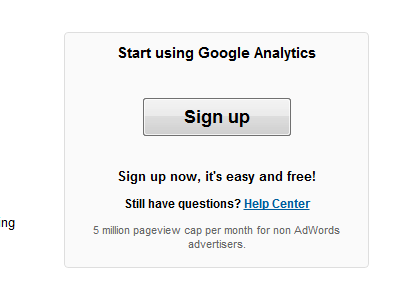
Setting up your Google Analytics account is pretty easy; as with all other Google accounts, you can use a single sign in to access your account. Go to www.Google.com/analytics
Click “Sign Up” in the upper right side of the page.
Enter the pertinent information for your site. Data sharing is your own preference, I don’t have anything to hide, so I don’t worry about it too much; you may feel differently. Once you’ve filled in the correct information, you must agree to the terms and click “Create Account.”
You are immediately taken to the screen where you can create your tracking script. This page is a tad intimidating, but don’t worry, this part will be painless.
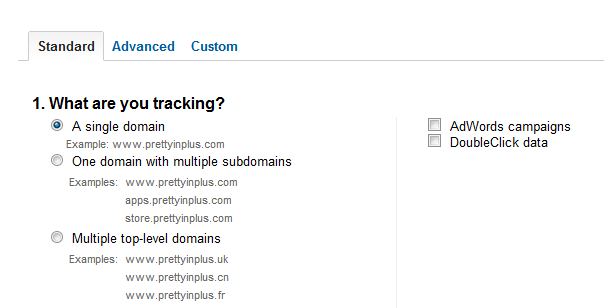
Scroll down to the tabbed area that says “Standard” and make sure the “Standard” tab is selected.
From here, you need to make some decisions. If you have only one domain, with no sub-domains and no other domains you need to track, you choose the radial button next to “A single domain.” If you are tracking a sub-domain along with a main domain, or two entirely different domains, make the correct selection.
If you’re using AdWords, you’re going to want to enable AdWords domain tracking with the check box to the right of the domain options. If you’re not yet doing AdWords, but plan to, go ahead and check the box.
If you’re not sure, you can always come back to this section and edit it. **Note – if this section is edited, the script will change and you need to change the scripts on your website.
You’ve now configured the basic tag. The script is ready for installation on your website. Inevitably, there will be other metrics you’ll want to configure, those can come at a later date. For now, start with the basic tag and see what the data for your website looks like.
If you’d like to track e-commerce functions, you’ll need to read the documentation closely to figure out the best way for your shopping cart setup.
There are a variety of variables and tweaks that need to be considered. You might need to track sales tax, whereas some sites do not. Figure out what variables you need to track and work on adding each one to your tracking script. You can find documentation on configuring ecommerce tracking in the Google Developer’s help section.
Note: Remember, if you’re going to an off-domain shopping cart – either on a sub-domain or an entirely different website – you’ll need to adjust the standard tracking script setup above accordingly.
Step 3 – Installation
Once you’ve made the correct selections, you can then copy your script into your site. The script should go at the top of the page right before the </head> tag – some content management systems give you a special place to enter tracking scripts. Be familiar with what you have to make sure you’re installing the script correctly.
You can also choose to email the instructions to your webmaster just below the box that contains the code.
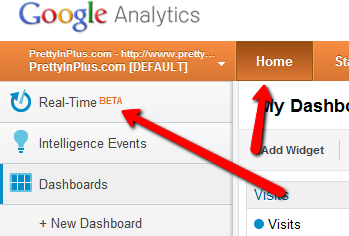
Voila! Basic tracking is set up and installed on your site. There is usually a delay in reporting under the “Standard Reporting” section of Google Analytics, sometimes a few hours, sometimes a few minutes. To see traffic to your site immediately, check out the “Real Time” tracking available within analytics.
Click “Home” in the orange bar, in the upper-left corner, click “Real Time” and you’ll see what is happening on your website right away.
If your site is brand new, you might need to enlist family and friends to land on some pages so you can see their activity. Actual visitors are the best indicator of correct installation. You can also check to be sure your script is installed on every page of your site using the tool atAnalyticsCheckup.com.
Having the basic data related to what is happening on your website is key to making decisions about nearly everything related to marketing. Without a way to measure results, you’re making changes based on guesses and suggestions from Aunt Pammy down the street. Get set up correctly and you’re going to start making smarter decisions right away.
Earlier this week, the New York Times spotlighted how a merchant with bad reviews nonetheless was ranked well in Google. Today, Google has announced that changes to its ranking system are in place to prevent such things from happening again.
Collecting Reviews But Dodging If They’re Used
Google aggregates reviews about merchants from across the web, as well as through its own Google Checkout system. With Google Product Search, merchants have an overall reviews page — the screenshot to the right is an example of this.
It seems likely that Google is now using these reviews as part of its ranking algorithm, though it never explicitly says this:
In the last few days we developed an algorithmic solution which detects the merchant from the Times article along with hundreds of other merchants that, in our opinion, provide a extremely poor user experience. The algorithm we incorporated into our search rankings represents an initial solution to this issue, and Google users are now getting a better experience as a result.
When I asked if reviews were being used, I was told:
As we mentioned in the blog post, we cannot reveal the details of our solution—the underlying signals, data sources, and how we combined them to improve our rankings—beyond what we’ve already said.
But Reviews Probably Are Used
I think these are being used. As you’ll see further below, Google talks about how it is NOT using reviews as something it will display in its results, because that alone wouldn’t be enough to “demote” sites. What would? Using the reviews as part of the ranking algorithm.
Also further below, Google talks about how it’s NOT using sentiment analysis to determine if links to pages indicate something good or bad about a merchant.
That leaves Google with few options to tell if a merchant has a good or bad reputation — and yet, it says it has a mechanism now in place to determine if a poor user experience is happening. I think this means tapping into reviews that it already collects.
That doesn’t mean reviews necessarily override all other ranking signals but rather that they are yet another factor among many to be considered.
It sure would be nice if Google would just confirm it, of course.
Sentiment Analysis Not Done
The post also explains that some things that were suggested as solution to the bad merchant problem, such as sentiment analysis, are technologies it has but doesn’t use, as they wouldn’t be deemed as helpful.
In particular, Google explained how some links from review sites were “nofollowed” and thus not providing link credit, while in other cases, links from news sites like the New York Times or Bloomberg to the merchant had little positive or negative sentiment to detect.
Reviews Not Being Displayed Alongside Listings
Google also talks about the idea that in the future, reviews about merchants might be displayed next to their listings, in the way that’s currently done for local businesses:
Yet another option is to expose user reviews and ratings for various merchants alongside their results. Though still on the table, this would not demote poor quality merchants in our results and could still lead users to their websites.
Google’s “Gold Standard” Search Results Take Big Hit In New York Times Story covers the New York Times story and examines in particular how merchant reviews were known to Google but apparently not part of the ranking algorithm, as well as how they might be displayed to warn users about merchants with poor records.
Postscript: I’ve now had a chance to check on the merchant, Decor My Eyes, that was spotlighted in the New York Times article. For one of the key terms discussed, it’s gone:christian audigier glasses doesn’t have Decor My Eyes in the first page of results.
However, chanel 5117 sunglasses does still bring the merchant up, in fact, right at the top of the page after the ads:
I then drilled down into some further specific searches, such as:
chanel 5117 sunglasses
Cazal 932 Sunglasses
Chanel 3142B Eyeglasses
Gucci Eyeglasses – Discount Designer Sunglasses
Hugo Boss 11062 Eyeglasses
Versace 2051 Sunglasses
Guess GU 6439 Sunglasses
alexander mcqueen 4039 sunglasses
club monaco 6517 sunglasses
club monaco 6517
None of these brought the merchant up. I’m not sure if it was ranking for these before the change or not. Typically, when I looked at these types of specific searches in the past, I would find the site. I do know it has matching pages on all these topics which are not showing in the first page at Google now. So, the change seems pretty effective.
Postscript 2: In the comments below, you can see the point raised that Google never actually says it is using merchant reviews. I’ve updated this story to reflect that.
t’s not everyday you get to hear from someone that’s worked on Google’s Search Quality/Webspam team and isn’t named Matt Cutts.
But Andre Weyher, whose LinkedIn profile lists a two-year stint as a member of the search quality team, recently spoke with James Norquay, a search/digital marketer based in Australia, and shared some interesting comments that may — and I’ll say more about this below — help search marketers and webmasters understand a little better how Google views certain SEO strategies and tactics.
NOTE: Before publishing, we asked Google for a comment on this story. It declined. A day after publishing, Google got in contact to say that Weyher “didn’t work on webspam engineering or algorithms at Google” and said it found inaccuracies in what he said. The postscript below has Google’s full statement. Weyher has also responded to say that while he wasn’t an engineer, he did work within the webspam team. His statement is also in a postscript, below.
Weyher explains that each person on the search quality team covers a certain “market” or “specialization.” His was content quality and backlink profiles. Below, some of the quotes that I found most interesting from the interview along with a comment or two from me in italics where appropriate.
On Link Building
“Everyone knew that Penguin would be pointed at links, but I don’t think many people expected the impact to be as large as it turned out to be. At this stage a webmaster is out of his mind to still rely on techniques that were common practice 8 months ago.”
He’s referring to the Penguin update that launched in late April, of course. Google estimated that it would impact about three percent of search queries. There have been two Penguin updates since: in late May and early October.
“Not only this but take PR for example, getting a link from a high PR page used to always be valuable, today it’s more the relevance of the site’s theme in regards to yours, relevance is the new PR.”
“…don’t dismiss directories completely. I have heard people talking about directories being altogether bad and advise people to avoid them. This is not the case, good quality, moderated directories, or niche directories are still worth looking in to.”
On What Makes A Spammy Link Profile
“There are a good few elements taken into account here, like how many links are there in total? A very important one; what is the quality of the pages they come in from? Do the pages look “real” or are they just there to host the links? What anchors are used? The commercial vs. non commercial ratio of the anchors.”
One of the most common post-Penguin pieces of advice that I’ve seen is to vary the anchor text of links pointing to your website. This interview seems to confirm that Google is (or was) looking at anchor text ratios.
On On-page SEO
“Of course you can’t over-do it as Google now also penalises for over optimisation, so don’t putt [sic] more than 2 commercial keywords in your titles or Google will frown upon it.”
Google might disagree with this quote. There was talk earlier this year that Google was planning to penalize for over-optimization, but when the Penguin update launched, Matt Cutts clarified that “over-optimization wasn’t the best description.” See our Penguin launch article for more on that. Also, I’ve never heard any other Googler make such a specific comment about keywords in title tags.
“Try to work on your website as if SEO was not part of your plan.”
“…what I tend to tell people is the following; if you want to please Google with your SEO, then forget about SEO.”
This echoes a theme that I’ve seen many smart SEOs talk about this year. Probably the best article on this idea is Adam Audette’s SEO Should Be Invisible.
Final Thoughts
We reached out to Google, but the company declined to comment on the interview.
The interview offers what I think is an interesting and potentially valuable look into how Google views certain SEO strategies and tactics in relation to its search quality and anti-webspam efforts. But I think it’s also important to keep in mind that these are the views of just one member of a large team at Google. As with any interview, it’s up to us as readers to try to separate the proverbial wheat from the chaff — i.e., what may reflect Google’s views versus what may be the interviewee’s opinions.
Postscript (Oct. 17): Google has now decided it does want to comment on this post, telling us about Weyher:
He didn’t work on webspam engineering or algorithms at Google. Given that we saw several incorrect statements in even this quick interview, we’d recommend sticking to trustworthy sources for accurate info on how Google works.
Postscript 2 (Oct. 17): Weyher tells us:
I wasn’t an engineer and wasn’t responsible for creating the algorithm in any way. No one within Google knows the entire picture apart from maybe 1 engineer, 1 level under Larry Page.
My tasks in the search quality team under Matt Cutts were executing Google policy, especially content quality rating and quality of backlink profiles, applying appropriate penalties and creating reports that would be taken into account by the webspam engineers.
By reviewing literally thousands of cases of what NOT to do, you learn what the limits are and from what exact point Google starts seeing something as spammy.
My answers in the original interview were based on my experiences in the 2 years I was on the team. Of course it’s important to mention that I am not an official Google spokesperson but certain things that I have learnt at my time in Google are still current.
As far as elements like commercial keywords in titles are concerned, I don’t think anyone would doubt that Google doesn’t like on-page over optimization. You can give it another name but it comes down to the same thing: try to make your page only search engine focused is not something Google likes.
It’s hard for me to comment about any incorrect statements without Google describing which were incorrect.
Social media marketing refers to the process of gaining traffic or attention through social media sites.
Social media itself is a catch-all term for sites that may provide radically different social actions. For instance, Twitter is a social site designed to let people share short messages or “updates” with others. Facebook, in contrast is a full-blown social networking site that allows for sharing updates, photos, joining events and a variety of other activities.
Why would a search marketer — or a site about search engines — care about social media? The two are very closely related.
Social media often feeds into the discovery of new content such as news stories, and “discovery” is a search activity. Social media can also help build links that in turn support intoSEO efforts. Many people also perform searches at social media sites to find social media content.
Advice At Search Engine Land
Here at Search Engine Land, we provide social media marketing information and news in a variety of ways:
Search & Social is Search Engine Land’s column that covers different social media marketing topics every week, as they relate to search.
In addition to covering social media marketing generally, Search Engine Land also has areas specifically about particular major social media sites and social search sites:
Marketing Land is the sister site to Search Engine Land that covers all facets of internet marketing, including social media marketing. At Marketing Land, you’ll find regular news coverage about social media marketing. It also offers three dedicated columns on the topic:
Search Engine Land produces the SMX conference series. Many of our SMX events have topics that cover social media. There’s also our annual event entirely devoted to social media. Check out the site to learn more: SMX Social Media Marketing.
Looking for an easy-to-scan compilation of social media news? Check out Alltop. For compilations of the best articles on paid search in a given year, visit The Semmys. At Search Engine Roundtable, you’ll discover a regular compilation of important discussions happening on a variety of search marketing forums.
Also be sure to subscribe to our free SearchCap newsletter! SearchCap has a recap of all the day’s social media marketing news from sources all over the web, as well as the day’s news from Search Engine Land and Marketing Land.
Using links as an Off The Page ranking factor was a great leap forward for search engines. But over time, links have lost their value for a variety of reasons. Some sites are stingy about linking out. Others block many links to help fight spam. Links get bought and sold, making them less trustworthy.
Enter social media. If links were a way for people to “vote” in favor of sites before, social media sharing is a far earlier way for that type of voting behavior to continue. Social signals are continuing to rise as an important ranking factor that search engines are using.
Sr: Social Reputation
Just as search engines don’t count all links equally, nor do they view all social accounts as being the same. That makes sense, since anyone can easily create a new account on a social network. What’s to prevent someone from making 100 different accounts in order to manufacture fake buzz?
Nothing, really, other than fake accounts like these can be easy to spot. They may have few “quality” friends in their network. Few might pass along material they share.
Ideally, you want to gain references from social accounts with good reputations. Having a social account with a good reputation of its own is great, too. So participate in the social world in a real, quality way, just as you would with your web site.
To understand more about how search engines are making use of social signals, see this in-depth report below:
Similar to links, while getting quality social shares is ideal, being shared widely on social networks by many is still helpful.
Again, participation in social sharing sites is crucial. If you don’t have a Twitter account, a Facebook fan page, a LinkedIn group, you’re missing out on opportunities to be easily shared. You’re not building up a network that can help spread the news.
What about Google’s recently launched Google +1? That is yet another form of social share, and one that Google says definitely is a factor in your favor for rankings.
To learn more about Google +1 along with other social sharing tips and social’s impact on search results, see the Search Engine Land articles below:
Links were the first major “Off The Page” ranking factor used by search engines. No, Google wasn’t the first search engine to count links as “votes,” but it was the first search engine to massively depend on link analysis as a way to improve relevancy.
Today, links remain the most important external signal that can help a web site rise in the rankings. But some links are more equal than others….
Lq: Link Quality
If you were sick, which would you trust more? The advice of five doctors or fifty people you didn’t know but who offered their opinions as you walked down the street.
Unless you’ve had a really bad experience with doctors, you’re probably going to trust the doctor advice more. Even though you’re getting fewer opinions, you’re getting those opinions from experts. They’re quality opinions.
In the same way, search engines do count all the links pointing at web sites (except thoseblocked using nofollow or other methods). But they don’t count them all equally. They give more weight to the links that are considered to be of better quality.
What’s a quality link? It’s one of those “you’ll know it when you see it” types of things, in many cases. But a link from any large, respectable site is going to be higher on the quality scale than a link you might get from commenting on a blog.
To learn more about link quality and how Google in particular examines links, see this tutorial from us:
Also be sure to check out our Link Week column, which provides information about link building every week.
Lt: Link Text / Anchor Text
Amazon has millions of links pointing at it. Yet, it doesn’t rank for “cars.” It does rank for “books.” Why? Many of those links pointing at Amazon say the word “books” within the links. Relatively few will say “cars,” since Amazon doesn’t sell cars.
The words within a link — the link text or “anchor text” — are seen by search engines as a way that one web site is describing another. It’s as if someone’s pointing at you in real life and saying “books,” declaring you to be an expert on that topic.
Often, you can’t control the words people use to link to you. But if you have the opportunity to influence this, you should seek to. It’s a powerful ranking factor.
To learn more about anchor text, see our tutorial below:
While you want link quality over sheer number of links, plenty of sites have found that getting many links can add up.
In particular, viral linkbaiting campaigns can be effective and something even search engine representatives have suggested.
But in your quest for links, don’t fire up automated software and begin blog spamming. That’s a bad thing, in many ways, as we’ll explore later in this guide.