investment, how to make money with survey, seo, reading email, clicking ads, social media, links, internet, profit always, get high ranking, visitors and traffic,
The WordPress tips and hacks mentioned below apply to a self-hosted installation of WordPress. You may skip if your WordPress blog is hosted on WordPress.com and not WordPress.org.
Tip 0: Change the Default Image Upload Folder
The default installation of WordPress will store all your images inside wp-content/uploads folder.
Presenting the 101 most useful websites of 2012. These sites, well most of them, solve at least one problem really well and they all have simple web addresses (URLs) that you can memorize thus saving you a trip to Google.
The Most Useful Websites and Web Apps
screenr.com – record movies of your desktop and send them straight to YouTube.
Ranking high in Google’s search results can have a phenomenal impact on the success of your business. You probably knew that already. But did you know that there are a few simple changes you can make yourself that can have a tremendous impact on your SEO?
# 1: Keyword Research What keywords do you think your customers would type in to search for your products or services? A keyword can be one word (e.g. “optimization”), but multiple keywords or keyword phrases are usually preferred, because they are more specific and more likely to be what your customers are looking for.
Write down as many as you can think of. Brainstorm with your team. Think of alternative words. Consider geographical phrases if they are important to your customer. Also, get some ideas from your competitors’ websites. Try to make a list of 20-30 keyword phrases.
Choose the two keyword phrases you think would be searched for the most. But also remember, the more competition there is for a keyword, the harder it is to achieve top rankings. If you want to rank high in Google for the keyword “insurance”, you have a very long journey ahead. So try your best to select two keyword phrases that are the most relevant to you business but that are not vague nor competitive. It’s a good idea to have 2 or 3 words in each phrase (e.g. “wedding catering services”)
#2 Web Copy Web copy refers to all the words or text on your website. Because content is king in the world of search engines, your keyword phrases need to be placed strategically on your webpage to convince Google that your content is highly relevant to those keywords. The more prominent they are, the better. (Keep in mind that as important as search engines are, customers come first, so make sure your copy also reads well.) Here’s how you can increase each keyword’s prominence: • Place your keywords in headings, preferably at the beginning of the heading; • Include keywords towards the top of the page; • Bold or italicize keywords where appropriate; • Instead of having a link to another page that says “Click here to read more “, reword it to include your keywords.
An important tip is to also include these keywords in your HTML “title tag”. Use your content management system to make these changes yourself, or perhaps ask your web developer to do it if you’re unsure how.
Once you have fine-tuned your home page, consider adding new content, such as detailed descriptions of what you offer, FAQs and informative articles about your products and services.
It’s also good to bear in mind that search engines can only read text, not pictures. Often web developers embed words in images to look better for website visitors or use Flash for animation, but this is a major impediment to search engines.
#3 Linking Each link from another website to your website (not from your website) is considered by search engines as a vote of popularity for your business and will improve your rankings. But it is the quality, not quantity, of the links that is crucial. The other websites should be relevant to your industry, and preferably highly regarded themselves. Ten quality links count far more than 500 links from arbitrary websites. In the same way your personal business network can have a significant impact on the success of your business, so too the online network you build on the internet.
Brainstorm all the relevant websites that could link to you, such as non-competing companies, and industry bodies and organizations. Write a friendly email to each describing the benefit their visitors would get in knowing about your business, and request them to create a link to your website. Most people will not respond first time round, so a follow-up phone call is usually required. How do I monitor my results?
Monitor your rankings in Google over the next few months by typing your chosen keywords into the search box, and recording your ranking. Also look at your hosting reports to understand what search terms your visitors are using to find your website.
The above process can be also be repeated for each page of your website. Remember to keep updating your content, and continually increase the number of links to your website.
Ask your virtual assistant
And the best part of all? This is an easy task to hand your virtual assistant. A good virtual assistant can do the keyword research for you, make changes to your web copy and identify potential quality websites that could provide quality links to your website. He/she can also reach out and contact those sites for you.
Are you thinking of new ways to get visibility for your business in the coming year? Put your virtual assistant to work on a project like this now and be ready for more visibility and traffic to your website in the new year!
With hundreds, thousands, tens of thousands, and even millions of pages, sites, and keywords to manage and optimize, enterprise SEO has become increasingly complicated and time-consuming. Using an enterprise SEO software platform can increase efficiency and productivity while reducing the time and errors involved in managing organic search campaigns. More specifically, automating SEO through a toolset or platform can provide the following benefits:
Many tools, one interface.
More efficient management of global operations.
The ability to stay up-to-date with the search engines
Automated reporting to provide data in near real time
Enterprise SEO Platform Pricing
Licensing an enterprise SEO platform can be a significant investment, particularly for ecommerce or retail marketers with hundreds of thousands of SKUs or product pages. Marketers typically spend tens of thousands of dollars each month in licensing fees, and pay for installation and staff training to maximize the value of the platform and its capabilities.
Virtually all SEO platforms are provided on a software-as-a-service (SaaS) basis, i.e. the vendor makes the software available online and is responsible for all maintenance and system administration. Pricing models vary significantly from pay-for-performance, to keyword- or page- volume based, to completely customized based on volume and program scope.
Determining your overall cost can be more art than science and based upon your brand’s keyword, link building, international coverage and other SEO activities. As a result, few vendors require an annual contract, preferring month-to month licensing that is flexible as programs grow or contract. Several vendors offer a free trial lasting from 14 to 30 days. It may be beneficial to ask for an SEO pre-analysis, even if it means paying a modest fee for it, to determine the actual costs and benefits of licensing an SEO platform.
Does Your Company Need an Enterprise SEO Platform?
Deciding whether or not your company needs an enterprise-level SEO platform calls for the same evaluative steps involved in any software adoption, including a comprehensive self-assessment of your organization’s business needs, staff capabilities, management support, and financial resources. Use the following questions as a guideline to determine the answers.
Do we have the right human resources in place?
Do we have C-level buy-in?
Do we have the right technical resources?
Who will own enterprise SEO?
Can we invest in staff training?
Do we have realistic expectations?
Enterprise SEO Platform Capabilities
SEO software comes in many shapes and sizes, from rank-checking tools to keyword research toolsets to full-service platforms that manage keywords, links, competitive intelligence, international rankings, page optimization, and workflow rights and roles. Enterprise-level platforms may also provide keyword and site analytics that include predictive scoring systems to identify the potential opportunities to improve brand websites, link authority and keyword rankings. Several vendors, namely BloomReach and Altruik, are implementation -- rather than analytics -- applications. Altruik proxies websites to automate many SEO implementation tasks. BloomReach optimizes page content to drive incremental new traffic to websites by improving content relevancy to search visitors.
Virtually all enterprise-level SEO platforms available today offer these capabilities:
Keyword research and rankings
Link (also called backlink) research and analysis
Competitive intelligence
International search tracking
The platforms begin to differentiate by offering additional or expanded capabilities, sometimes requiring additional investment, that include but are not limited to:
Key performance indicator (KPI) and management dashboards
Workflow and task management
Universal search rankings
Social signal tracking
Web analytics integration
Scalability to manage thousands or millions of pages and keywords
Six Questions to Ask Potential SEO Platform Vendors
Ready to talk to SEO tools vendors? Here are six questions you should ask:
How is your search volume calculated?
Can this system track millions of searches, visits, site pages, etc?
Do you support international search?
How robust and flexible are your reporting options?
What other meta-information does your system collect that may be made available to me via API?
Is there a workflow built in that allows me to coordinate the work of my marketing, content, web development, social media and PR teams across the organization?
Handling established campaigns across multiple countries can quickly become a case of handling overwhelming quantities of data interspersed with never-ending menial jobs, preventing the SEO from developing their strategy to squeeze yet more value from their campaign ROI.
Here is part one of a two-part guide to some of the key automations our team uses to keep on top of the game internationally.
Segmented ‘Micro’ Reports
Based on the effectiveness of simple spark-line graphs and minimal data points in relevant context, micro reports should give you a quick, visual view of the campaign state of play within the context of the preceding week and the same period last year.
Result: Fast, flexible reports on key metrics with no clutter and no analysis(!).
Regardless of the metrics measured however, the report should be comprehensive in covering all areas of the campaign – so include things like click data from the last email campaign, for example – and should not include any dialogue: save that for monthly review reports.
Here’s my absolute minimum weekly KPIs for keeping an eye on just SEO & PPC multinational campaign ROI (I’ve left out Affiliates, Social, Display, etc for simplicity’s sake but can revisit if there’s enough interest).
For all reports, run for the total campaign, and for each target country in your campaign.
1. Total Organic / PPC / Total Visits
For each channel and country: 12 month sparkline; last week’s timeline with previous week and YOY comparison lines; percentage non-brand in the week and average for month vs. same month last year.
What you’re looking out for here: sudden slips, particularly in the year on year numbers. Most verticals have a distinct annual trend. Are you outperforming it when it counts? Are you simply seeing a rise because there’s always a rise?
Also, you should always look to increase your non-brand percentage because it will drive a higher proportion of new visits, growing overall sales rather than cannibalising traffic sales initially driven by another channel.
2. Top 25 Non-Brand Organic / PPC Keyphrases Driving Visits
For each channel & country: table w/ term, 12 month sparkline, visits, +/- week, +/- month, +/- YOY month.What you’re looking out for here: new breakthrough terms, and high value performance terms slipping.
Again, take seasonality into account, especially for organic. PPC YOY comparisons should be further investigated if dramatically different: has budget allocated to the term changed: why? Is it intentional, and if so was it based on CPC or CPA? Was it a valid decision or should it be reviewed?
Similar to the above point, only this time also pull in revenue generated +/- week, +/- month, +/- YOY month for converting traffic fitting the criteria.
4. Top 25 SEO ‘Opportunity Keyphrases’
For each country: term, rank, impressions, clicks, ranking URL, URL <title>, URL Meta Description.I define an ‘Opportunity Keyphrase’ as a relevant search term which has high potential traffic associated with it, that my site is currently ranking outside of the top three search result terms, but within the top 10 (inclusive).
Why are these terms worth giving special attention to?
Simply because we know that SERP clickthrough rates go up exponentially as you approach position one in the SERPs, therefore for high traffic terms, moving from position 4-10 to 1-3 will have a significant bottom line impact to your traffic.
Every URL flagged in this report should be scheduled for onpage auditing of its SEO around the highlighted term, and should have an internal and external linkbuilding strategy executed over the following week.
Of all the micro reports, this is the most useful to also send to the local country teams to act as a guide to upcoming optimisation work, but also as a reminder of the importance of core areas of optimisation (after they implement the recommended work, inevitably you’ll see the terms switch up into top three rankings on a well set-up domain).
5. Top 25 SERP Conversion ‘Opportunity Keyphrases’
Similar to the above report, except this time our focus is on SERP results where we areperforming in the top three, but are not converting impressions to clicks well enough. This time, we should be scheduling a local copywriter to review the <title> and meta description for suitability in converting searchers on the highlighted search term in their country.
Conversion Funnel ‘Points of Failure’
I call this report the ‘Points of Failure’ because a well set up conversion funnel should strive to achieve 100% conversion (although this is of course impossible!). For each country, a straightforward recreation of a funnel (a la Google Analytics’ Goal Funnel) fornew site visitors with +/- week on week, and +/- year on year is sufficient to get a good feel for where progress is being made (or not!).If you’re running major funnel optimisation then include page load speed info for your funnel URLs.
Site Speed
For each country: run for sitewide, and top 25 slowest URLs, avg. page load time, +/- week on week, and +/- year on year. Watch out for erratic results week on week as well as any sudden drops. Both are indicative of a struggling server and require further investigation into server capacity and tolerance.
Obviously, you’re striving to ensure you get as fast as possible page load times – certainly for the DOM execution to improve user experience. But remember, Google uses ‘Headless’ page execution to incorporate JavaScript execution into page rendering times so pay particular attention to parallelising your static assets and ensure you follow every best-practice piece of advice out there (page speed is nothing new!).
You may find it useful to build testing tools using PhantomJS for more robust Page Speed reporting tools.
Until Next Time, Happy Micro Reporting
So that’s my bare minimum micro-report suite recommendation. Everything in here can be automated and the data can be largely gathered from Google Analytics and Webmaster Tools for that purpose.
Hopefully you’ll find the micro-report useful to spot sudden changes in activity across a range of data points, and come to appreciate its use as a bellweather for the campaign. It should, of course, not replace more considered monthly reporting containing insightful commentary and action points.
Part two of this post (next month) will cover Alert Triggered Reports, and how we can use automation to save us at critical campaign moments of crisis.
Remarketing has been around for quite a while as part of the Google AdWords suite of tools. Remarketing works by creating a “list” or “audience” within Google AdWords. The pages that are pertinent to that audience are tagged with special code that allows Google to place a cookie in the browser of anyone who visits that page.
It’s a great way for you to get your brand out there in front of your website visitors, even when they’re not thinking about shopping and buying from your site. There are tons of ways for you to segment your website to serve remarketing ads; you can even get as granular as per-product remarketing.
Think of the power of being able to show someone the exact used car they viewed on your website – on many sites they visit after they’ve left you, for up to 30 days. New sites, social media sites, email accounts, etc. All can remind your shopper of that great car they looked at. If they bought it, your brand and their choice can be confirmed in their mind, this could help alleviate buyer’s remorse.
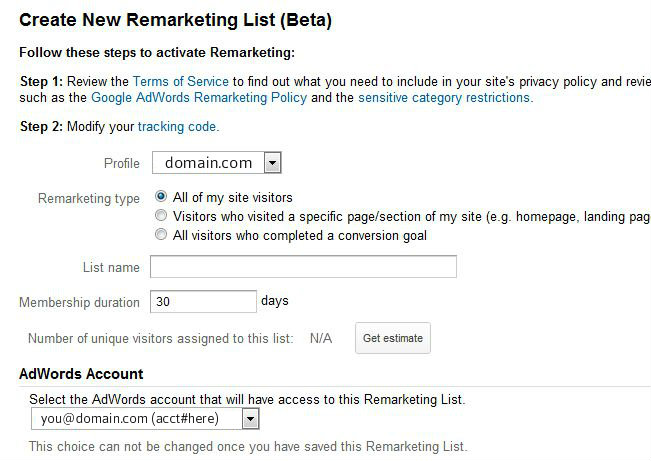
Previously, we created lists based on sections or products within our site, there was some guesswork and some analytics involved in creating these marketing lists. Now we can useRemarketing with Google Analytics to create a marketing list for those that spend a specified amount of time on your site, or place items in the shopping cart.
Available to Analytics users who are administrators with at least one linked AdWords account, as of July 27th this feature was in beta and being rolled out by the end of the summer.
You can find the remarketing information by clicking on the “Admin” tab in the upper right corner of Analytics, and then find the tab that says “Remarketing Lists”:
With Remarketing with Analytics you can now create one tag, but serve different ads based on the specified parameters, be it time, shopping cart interaction, number of pages viewed, etc.
Google Analytics will help you create lists to use as audiences in your Google Remarketing campaigns, and send them to your AdWords account with the click of a button.
You can use the setup to create a marketing list for those that spend a specific amount of time on your site, or visit a specific section or complete a goal. You can have a remarketing campaign for shoppers who view pink sequin sneakers and add them to your shopping cart, but don’t buy them. You can also have a remarketing list for the “shoes” section of your website. The possibilities are endless.
True – one of the options is not “Spends X minutes on my site” – but you can pretty much createany kind of remarketing list by using a conversion goal.
Setting conversion goals is easy – and once they’re set, you can choose which configured goal after you choose the “All visitors who completed a conversion goal” radial button above.
Now we have a great way to target our audience, we need to be sure the ad copy stands up to the segmentation. This is not a “set it and forget it” proposition. You need to create and test your ad copy. You need to test ad sizes and if text ads work better than graphic ads.
There are a lot of choices on the display network. Try them all, see what works best. Because your analytics are hooked into your AdWords account, you’re going to see amazing data that will help you fine tune your campaigns.
Check out your placements every few weeks and ask Google to not show your ads on sites. Sometimes your ads will be shown on sites that you don’t like, or that aren’t the best match for your brand. You can tell Google to stop showing your ads.
By creating these marketing lists, and setting up graphics to entice users back to your website, you can gain advertising placements in places that you would never be able to afford through traditional display media. I’ve seen my clients’ ads on sites like FoxNews.com, AOL.com, CNN.com – placements small clients could never afford are now available for fractions of the cost.
If you’re an intermediate to advanced Google Analytics user, this article will probably be of little interest to you personally. I suggest you bookmark it anyway as a reference for clients or friends who are just starting out with Analytics.
As a long-time agency employee, I see many clients, prospects and even casual acquaintances with websites that feature absolutely no Analytics data. They have no idea what is going on, or what they’re missing because the visitors that come to their site disappear into a vacuum.
This article is meant to walk first-time installers through the process, with a few tricks and tips I’ve gleaned and picked up on along the way. Google does give pretty good instructions on basic installation, but if you couple their instructions with my tips, and you’re going to be off and running in no time at all.
Step 1 – Can You Edit Your Site?
You need to be able to edit your own site or have someone available to install the scripts for you. If you cannot meet either of these two criteria, you’re dead in the water.
You need to either a) redesign your site into a platform that is novice friendly and easy to edit (I always recommend WordPress, it’s not just for blogs) or b) get ahold of the person who designed your site and make sure they send you access to your content management system (CMS) or FTP logins. If you don’t know how to edit your site using FTP, you’ll need to find someone who does.
Step 2 – Creating The Tracking Script
Setting up your Google Analytics account is pretty easy; as with all other Google accounts, you can use a single sign in to access your account. Go to www.Google.com/analytics
Click “Sign Up” in the upper right side of the page.
Enter the pertinent information for your site. Data sharing is your own preference, I don’t have anything to hide, so I don’t worry about it too much; you may feel differently. Once you’ve filled in the correct information, you must agree to the terms and click “Create Account.”
You are immediately taken to the screen where you can create your tracking script. This page is a tad intimidating, but don’t worry, this part will be painless.
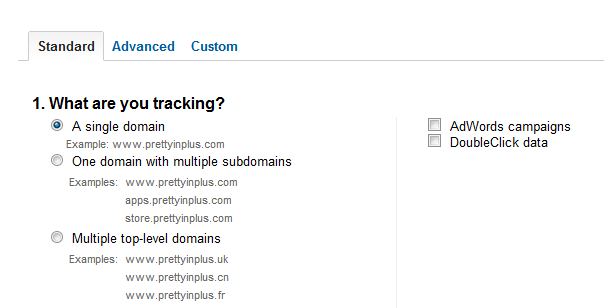
Scroll down to the tabbed area that says “Standard” and make sure the “Standard” tab is selected.
From here, you need to make some decisions. If you have only one domain, with no sub-domains and no other domains you need to track, you choose the radial button next to “A single domain.” If you are tracking a sub-domain along with a main domain, or two entirely different domains, make the correct selection.
If you’re using AdWords, you’re going to want to enable AdWords domain tracking with the check box to the right of the domain options. If you’re not yet doing AdWords, but plan to, go ahead and check the box.
If you’re not sure, you can always come back to this section and edit it. **Note – if this section is edited, the script will change and you need to change the scripts on your website.
You’ve now configured the basic tag. The script is ready for installation on your website. Inevitably, there will be other metrics you’ll want to configure, those can come at a later date. For now, start with the basic tag and see what the data for your website looks like.
If you’d like to track e-commerce functions, you’ll need to read the documentation closely to figure out the best way for your shopping cart setup.
There are a variety of variables and tweaks that need to be considered. You might need to track sales tax, whereas some sites do not. Figure out what variables you need to track and work on adding each one to your tracking script. You can find documentation on configuring ecommerce tracking in the Google Developer’s help section.
Note: Remember, if you’re going to an off-domain shopping cart – either on a sub-domain or an entirely different website – you’ll need to adjust the standard tracking script setup above accordingly.
Step 3 – Installation
Once you’ve made the correct selections, you can then copy your script into your site. The script should go at the top of the page right before the </head> tag – some content management systems give you a special place to enter tracking scripts. Be familiar with what you have to make sure you’re installing the script correctly.
You can also choose to email the instructions to your webmaster just below the box that contains the code.
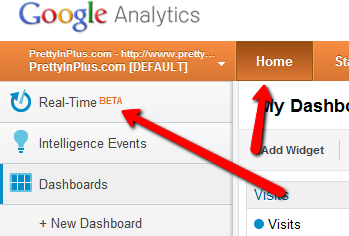
Voila! Basic tracking is set up and installed on your site. There is usually a delay in reporting under the “Standard Reporting” section of Google Analytics, sometimes a few hours, sometimes a few minutes. To see traffic to your site immediately, check out the “Real Time” tracking available within analytics.
Click “Home” in the orange bar, in the upper-left corner, click “Real Time” and you’ll see what is happening on your website right away.
If your site is brand new, you might need to enlist family and friends to land on some pages so you can see their activity. Actual visitors are the best indicator of correct installation. You can also check to be sure your script is installed on every page of your site using the tool atAnalyticsCheckup.com.
Having the basic data related to what is happening on your website is key to making decisions about nearly everything related to marketing. Without a way to measure results, you’re making changes based on guesses and suggestions from Aunt Pammy down the street. Get set up correctly and you’re going to start making smarter decisions right away.
Earlier this week, the New York Times spotlighted how a merchant with bad reviews nonetheless was ranked well in Google. Today, Google has announced that changes to its ranking system are in place to prevent such things from happening again.
Collecting Reviews But Dodging If They’re Used
Google aggregates reviews about merchants from across the web, as well as through its own Google Checkout system. With Google Product Search, merchants have an overall reviews page — the screenshot to the right is an example of this.
It seems likely that Google is now using these reviews as part of its ranking algorithm, though it never explicitly says this:
In the last few days we developed an algorithmic solution which detects the merchant from the Times article along with hundreds of other merchants that, in our opinion, provide a extremely poor user experience. The algorithm we incorporated into our search rankings represents an initial solution to this issue, and Google users are now getting a better experience as a result.
When I asked if reviews were being used, I was told:
As we mentioned in the blog post, we cannot reveal the details of our solution—the underlying signals, data sources, and how we combined them to improve our rankings—beyond what we’ve already said.
But Reviews Probably Are Used
I think these are being used. As you’ll see further below, Google talks about how it is NOT using reviews as something it will display in its results, because that alone wouldn’t be enough to “demote” sites. What would? Using the reviews as part of the ranking algorithm.
Also further below, Google talks about how it’s NOT using sentiment analysis to determine if links to pages indicate something good or bad about a merchant.
That leaves Google with few options to tell if a merchant has a good or bad reputation — and yet, it says it has a mechanism now in place to determine if a poor user experience is happening. I think this means tapping into reviews that it already collects.
That doesn’t mean reviews necessarily override all other ranking signals but rather that they are yet another factor among many to be considered.
It sure would be nice if Google would just confirm it, of course.
Sentiment Analysis Not Done
The post also explains that some things that were suggested as solution to the bad merchant problem, such as sentiment analysis, are technologies it has but doesn’t use, as they wouldn’t be deemed as helpful.
In particular, Google explained how some links from review sites were “nofollowed” and thus not providing link credit, while in other cases, links from news sites like the New York Times or Bloomberg to the merchant had little positive or negative sentiment to detect.
Reviews Not Being Displayed Alongside Listings
Google also talks about the idea that in the future, reviews about merchants might be displayed next to their listings, in the way that’s currently done for local businesses:
Yet another option is to expose user reviews and ratings for various merchants alongside their results. Though still on the table, this would not demote poor quality merchants in our results and could still lead users to their websites.
Google’s “Gold Standard” Search Results Take Big Hit In New York Times Story covers the New York Times story and examines in particular how merchant reviews were known to Google but apparently not part of the ranking algorithm, as well as how they might be displayed to warn users about merchants with poor records.
Postscript: I’ve now had a chance to check on the merchant, Decor My Eyes, that was spotlighted in the New York Times article. For one of the key terms discussed, it’s gone:christian audigier glasses doesn’t have Decor My Eyes in the first page of results.
However, chanel 5117 sunglasses does still bring the merchant up, in fact, right at the top of the page after the ads:
I then drilled down into some further specific searches, such as:
chanel 5117 sunglasses
Cazal 932 Sunglasses
Chanel 3142B Eyeglasses
Gucci Eyeglasses – Discount Designer Sunglasses
Hugo Boss 11062 Eyeglasses
Versace 2051 Sunglasses
Guess GU 6439 Sunglasses
alexander mcqueen 4039 sunglasses
club monaco 6517 sunglasses
club monaco 6517
None of these brought the merchant up. I’m not sure if it was ranking for these before the change or not. Typically, when I looked at these types of specific searches in the past, I would find the site. I do know it has matching pages on all these topics which are not showing in the first page at Google now. So, the change seems pretty effective.
Postscript 2: In the comments below, you can see the point raised that Google never actually says it is using merchant reviews. I’ve updated this story to reflect that.


 The WordPress tips and hacks mentioned below apply to a self-hosted installation of WordPress. You may skip if your WordPress blog is hosted on WordPress.com and not WordPress.org.